 X (Twitter)



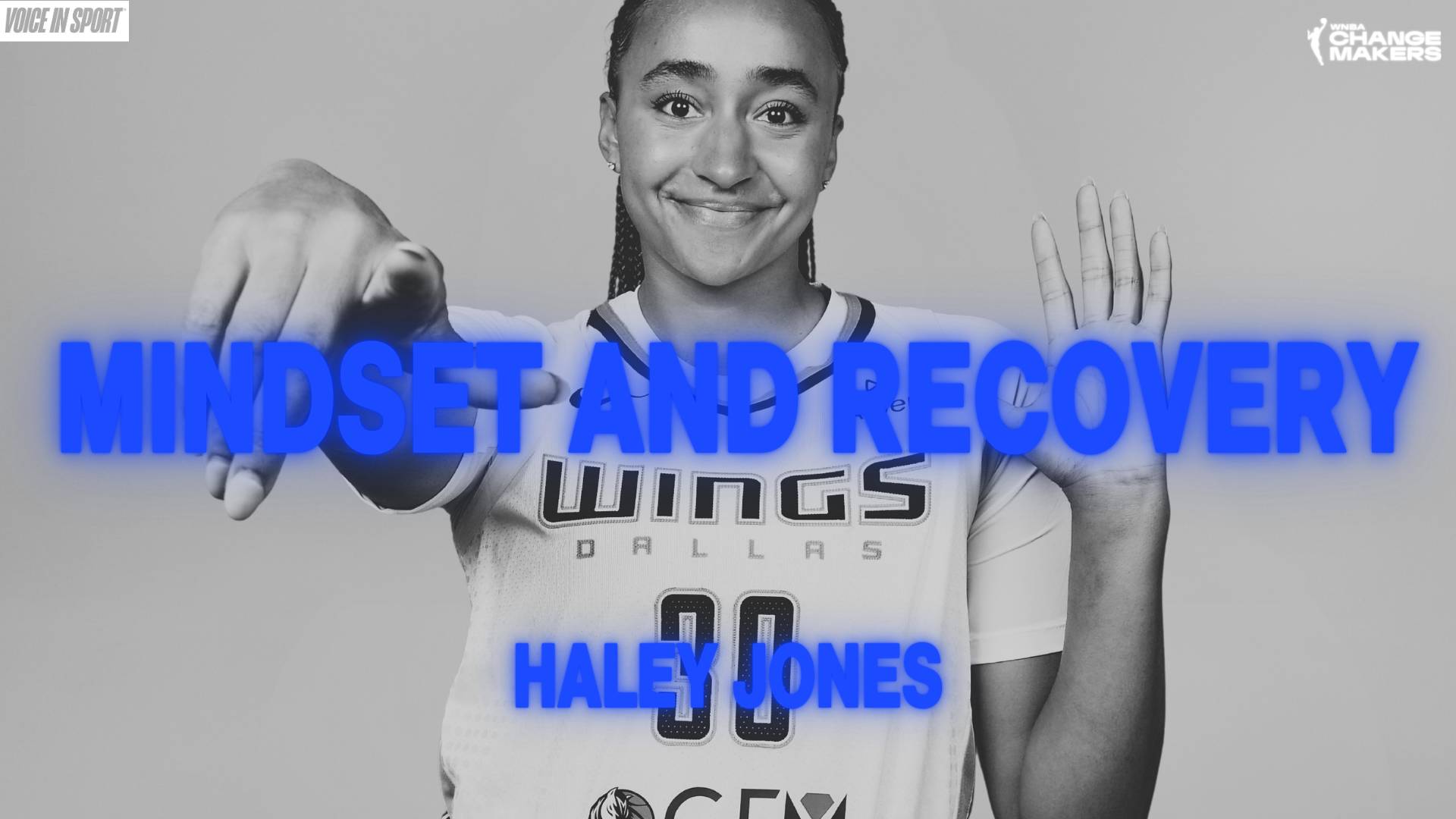
Competing at the highest level isn’t just about how hard you train—it’s about how well you recover, how you talk to yourself, and how clearly you understand your process.
WNBA guard Haley Jones has learned that lesson at every stage of her journey: from guarding her mom in the cul-de-sac, to rehabbing a major knee injury in college, to navigating the mental demands of the pros. In this playbook, Haley breaks down the mindset and recovery principles she believes every young woman athlete should know—and start using now.
1. Protect Your Process—Don’t Compare It
One of the biggest mindset traps Jones sees young athletes fall into is comparison, especially on social media.
“You see all these other people doing whatever they’re doing and you’re like, ‘oh, I need to do that to be successful,’” Jones said. “But you need to do what’s best for you.”
Jones didn’t have a personal trainer growing up. While other players were posting flashy workouts, she was learning the game in her driveway. At the time, it didn’t feel like enough—but it turned out to be exactly what she needed.
“That was my process. And that’s what worked for me,” Jones said. “I never let it feel like it was good enough, when in reality that’s what got me to where I was.”
The takeaway: Your journey doesn’t need to look impressive online to be effective. Comparison doesn’t make you better, but consistent, individualized work does.
2. Train With a Plan That Fits Your Game
Comparison often extends beyond long-term goals and can quietly influence your daily workouts before you even realize it.
“I'm watching these guards on social media do crazy moves,” Jones said. “And then I try to do that and I'm like, ‘Haley, you would never do that in the game. Why are you doing this right now?’”
Jones learned to stop copying workouts that didn’t fit her game. Watching guards online do moves she’d never use only pulled her further from her strengths. Instead, she learned to tailor her work to what actually translates on the court.
“Girl, you're a jab step type of girl. Focus on that. Be good with what you do,” Jones told herself.
Having intention in workouts also protects recovery.
“If you go in with a plan then you can be more efficient with your time,” Jones said. “That way, you're not overworking yourself.”
“If you go in with a plan then you can be more efficient with your time. That way, you're not overworking yourself.”
3. Mental Strength Underpins Physical Performance
Even at peak physical conditioning, performance can break down if you aren't mentally present. Physical recovery alone isn’t enough. True recovery includes resetting the mind.
“Without mental rest, burnout, fatigue, and low motivation will creep in, even if your body feels fine,” Jones said. “If mentally you're not there, you're not going to perform, you don't feel present. That's when injuries can happen when you're not focused.”
To stay mentally engaged, Jones creates small, tangible goals and clearly defines what she’s working toward. This reduces mental overload.
“You get better, but you don’t know what you’re working toward. So nothing feels fulfilling,” Jones said. “I think naming what you want to achieve is big.”
By clearly defining what she’s working toward and visualizing herself executing, Jones gives her mind something concrete to lock onto. That clarity quiets mental noise, supports recovery, and makes mental strength easier to access consistently, not just in high-pressure moments.
4. Everything Is Recovery
Recovery is a daily practice that extends beyond a single day off.
“Your sleep, the way you eat, the way you talk to yourself, all of those things play into it,” Jones said.
Jones emphasizes that even if you have a day off, staying up all night scrolling doesn’t count as rest. Neither does ignoring nutrition or skipping mental breaks. For Jones, recovery is something active and intentional.
“You don't want to be a couch potato all day during recovery. Go do something else you enjoy,” Jones said. “I know for me, I like playing pickleball or hitting balls on the golf range or I want to go on a hike. Figure out what your recovery is, not only physically, but mentally like taking your mind off of your sport.”
Intentional recovery is what allows your training to work. Without it, effort doesn’t pay back.
5. Talk to Yourself Like You’d Talk to a Teammate
Mindset is the foundation of performance, and self-talk can directly change outcomes.
“If you miss a shot and you’re like, ‘oh my gosh, I suck,’ do you think you’re making the next one? Probably not,” Jones said. “You want to be very encouraging to yourself. And I think that that can be really hard when you're not having your best game.”
Jones asks herself a simple question in tough moments: Would I ever say this to a teammate?
“If the answer is no, why would I talk to myself that way?” Jones said. “I'm not going to tell my teammate, ‘oh my gosh, you suck, stop shooting the ball, don't throw it to her anymore.’ You want to give yourself that same respect that you give to others and give yourself that same grace.”
That applies in the heat of the game and after. When watching film that may be hard to watch or comparing stats to a previous game, Jones emphasizes that prioritizing how you speak to yourself and having confidence in your abilities after hard moments can truly influence the way that you're performing.
“Also just having confidence in myself,” Jones said. “I'm like, ‘oh well I missed a layup, I’m pretty sure I've made 10,000 layups or more in my lifetime so I'm going to take the odds that I'm going to make the next one.’”
“Without mental rest, burnout, fatigue, and low motivation will creep in, even if your body feels fine. If mentally you're not there, you're not going to perform, you don't feel present. That's when injuries can happen when you're not focused.”
6. Fueling Your Body Is Part of Your Job
For Jones, nutrition is non-negotiable for performance and longevity—before, during, and after training as well as on rest days. Fueling well also requires an intentional mindset: choosing consistency, discipline, and recovery even when it’s not the easiest option.
“Like today, I'm on court for one hour, and I'm in the gym for two hours. If I didn't eat between workouts, and I didn't eat after and I'm going to go to bed at 4 a.m., this day is a wash. I basically didn't do anything,” Jones said. “You have got to think about maximizing what you're really doing. That way you're actually going to feel the rewards of your work.”
With more experience, Jones has learned that nutrition is about adapting to what her body needs in each stage of her career. What worked during her AAU days no longer supports her the same way.
“If I'm going and I'm eating how I used to in the AAU days where I would have nachos and a hot dog and some McNuggets before a game, I would literally vomit at halftime,” Jones said. “I'm 24 now. I can’t handle that.”
Jones also stresses balance rather than restriction, which makes the longevity of nutritional habits much easier.
“If I want a cookie, I'm going to have a cookie. I want to go have Dr. Pepper, so I'm gonna have a Dr. Pepper,” Jones said. “It's just like, maybe not every day or maybe don't eat five. Just figure out what works for you and understand it's okay to have it in moderation.”
7. When You’re Injured, You’re Still Growing
A major knee injury in college forced Jones to separate her identity from basketball. This experience permanently changed her perspective.
“When basketball was taken away, I was like, ‘who am I?’” Jones said. “I learned I’m not just a basketball player. I'm a student. I'm a friend. I'm a daughter. I'm a sister. I carry all these different identities beyond just a basketball player.”
While sidelined, she studied the game from the bench, learned her teammates’ tendencies, and developed leadership skills that made her better once she returned.
“There's different ways that you can think about your injury where, yeah, maybe you're not running around with them the same way, but you can still grow your game,” Jones said. “You can become a better teammate. You can find more of a voice being a leader from the sideline. There's so many ways that you can still better yourself.”
An injury may interrupt competition, but growth continues in ways that often go unseen.
“I learned I’m not just a basketball player. I'm a student. I'm a friend. I'm a daughter. I'm a sister. I carry all these different identities beyond just a basketball player.”
8. Build a Support System You Trust—And Stop Listening to the Internet
Jones learned the hard way that social media can sabotage mindset fast.
“After certain games, I’ve gone down the Twitter rabbit hole—‘Haley sucks, Haley’s awful,’” Jones said. “And my family was like, ‘Haley, you don't know user 5678, why are you talking to them? They don't even feel comfortable enough to put their face in the profile and they're just some internet troll.’”
The opinions that matter most come from people who actually know you and want you to grow, not tear you down.
“You don't just want a yes man. You want people to keep you humble, but they do it in a constructive manner where they're not just tearing you down,” Jones said. “You know that they want you to be great, to reach your potential. So those are the type of people that you want in your circle and want to ask for their viewpoints on how you're performing because they know you. You don't want to be searching Twitter.”
Equally important to Jones is learning to validate yourself, rather than seeking other people for validation.
“You don't want to be doing it for other people. You want to do it for you. And then you want to feel confident and celebrate your wins,” Jones said. “It has to come from you because then when you get caught up in all these other people, then you're never really going to feel fulfilled in what you're doing.”
Protect your mental space. Not every voice deserves access to your confidence.
The Takeaway
Haley Jones’ playbook is a reminder that elite performance is built on intention. Protect your process instead of comparing it. Train with purpose, not trends. Treat recovery as something you actively practice, not something that just happens. Fuel your body, reset your mind, and speak to yourself with the same respect you give your teammates.
Most importantly, understand that growth isn’t linear, and it doesn’t stop when things get hard. Whether you’re navigating setbacks, injuries, or pressure from the outside world, progress comes from clarity, consistency, and trusting what works for you. That’s how performance lasts.
