 X (Twitter)



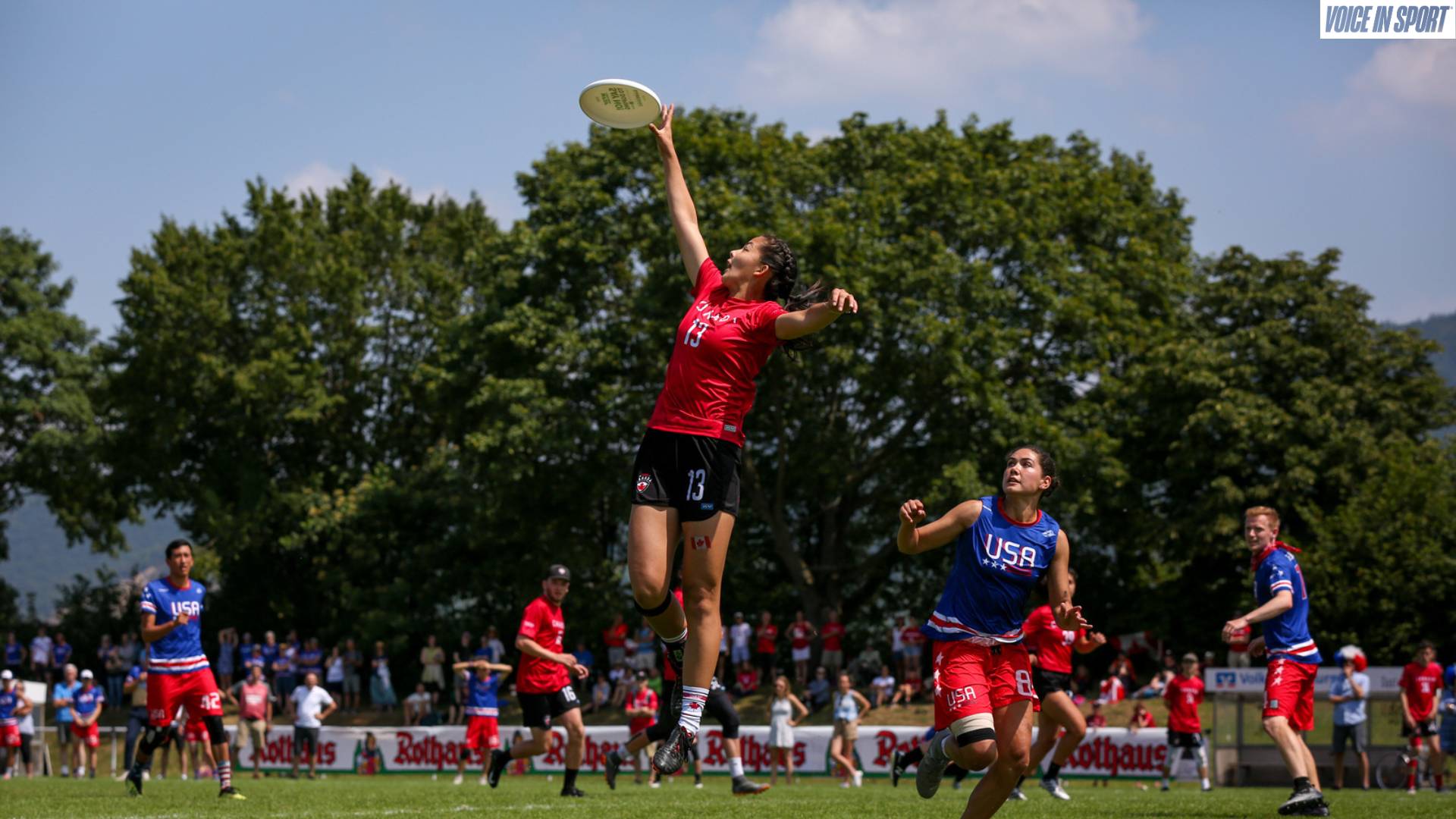
Before she became the first Canadian woman to win the The Callahan Award—the most prestigious honor in college ultimate frisbee—before she won a silver medal for Canada at the World Games, and before she led the University of British Columbia (UBC) Thunderbirds to a national championship, Mika Kurahashi was a teenager sitting in math class watching ultimate frisbee highlights.
A teacher had pulled up a video featuring elite players making diving layout catches and skying grabs. For Kurahashi, who had spent most of her childhood focused on soccer and other sports, it was the first time she saw what ultimate could be.
"I was getting a little bit tired of soccer at the time," Kurahashi said. "My math teacher showed us a Nathan Kolakovic highlight video, and that was actually the thing that first motivated me to try it out. It was cool to see young people making athletic plays.”
She was hooked almost immediately.
Her first high school season introduced her to a group of players who were constantly throwing together and pushing each other to improve. By the following summer, she was playing junior club ultimate. Soon after, she found herself attending a Team Canada prospect camp.
"I didn't make the team in the end at tryouts, but that was my first exposure to elite international play," Kurahashi said. "It gave me more understanding of what it meant to compete at that level and what the next steps would be to get there eventually."
Building a Legacy at UBC
When Kurahashi chose to attend UBC, ultimate played a major role in the decision. She knew the Thunderbirds had one of the strongest programs in Canada. What she didn't know was how deeply the team would shape her university experience. Her first year coincided with the COVID-19 pandemic, making it difficult to build connections on campus and her team quickly became her community.
"My experience playing ultimate at UBC has been a pretty defining part of my overall university experience,” Kurahashi said. “My first year was during COVID-19, and so in terms of social relationships and stuff, it was a little bit difficult for me to meet people. Really, the frisbee team became one of the biggest sources of my friends and relationships at UBC overall."
Kurahashi's first three trips to USAU Nationals followed a frustrating pattern. UBC was always close, but never quite where they knew they could be. The Thunderbirds finished fifth in her rookie season, climbed to third the following year, then dropped back to fifth in 2024 despite entering Nationals as the tournament's No. 1 seed.
"It always felt like we had a lot of talent and a lot of potential to be really successful," Kurahashi said. "I think falling short of that feeling of reaching our potential for a couple of years really motivated me to push myself and work really hard and really do everything that I possibly could to eventually achieve that goal."
That breakthrough finally came in 2025 when the Thunderbirds captured the national championship.
“I think falling short of that feeling of reaching our potential for a couple of years really motivated me to push myself and work really hard and really do everything that I possibly could to eventually achieve that goal.”
"It really felt like a culmination of all the years prior to that season for myself, but also all of the players that kind of came before us and had been working for that goal over the years,” Kurahashi said.
As captain through the 2024 and 2025 seasons, her leadership philosophy was never centered on herself. In BE Ultimate's Captain documentary series, Kurahashi reflected on the responsibility she feels to uplift those around her. She isn't naturally the loudest person in every room, but she believes leadership means ensuring every teammate has a voice. That perspective shaped the way she approached her final season at UBC.
Entering 2026 as defending national champions brought new pressure and expectations. Rather than focusing on repeating history, the team focused on appreciating the opportunity in front of them.
"We were really kind of just focusing on playing for each other and really appreciating being there," Kurahashi said. "Trying to remove that fear of losing and the pressure of living up to whatever expectations come with being the returning champions."
That mindset helped guide UBC through a slow start to the season. By the postseason, they were playing their best ultimate, carrying that momentum through Regionals and into Nationals as the tournament's No. 2 seed. Although the Thunderbirds fell one game short of another title, Kurahashi left with a different perspective than she had earlier in her career.
"We were able to come away still feeling really proud of the season that we had," Kurahashi said. "I think that's something that we maybe lacked in previous years. When we lost, we didn't have that same feeling of we still had a lot of success. It was more fixated on the fact that we fell short of the final goal of winning.”
More Than an Award
Less than 24 hours before UBC would take the field in the 2026 national championship game, Kurahashi stood on stage as the announcer recounted the accomplishments that had defined her career: Team Canada medals, a national championship, years of leadership, and a reputation as one of the most complete players in college ultimate. Around her, UBC teammates wearing white "Mika Kurahashi" t-shirts waited anxiously for the result.
Then came the announcement.
Kurahashi had been named the 2026 Callahan Award winner, becoming the first Canadian woman to receive the highest individual honor in college ultimate. As her name echoed through the microphones, her teammates rushed the stage, surrounding her with hugs and chants of "Mika! Mika! Mika!"
From the outside, it looked like the culmination of a remarkable season. She had led UBC back to the national championship game. She had cemented herself as one of the best players in the world. And now she had earned the sport's most prestigious individual award. But the honor also came at the end of a season that included some difficult chapters.
Earlier in the season, Kurahashi suffered a concussion that forced her away from ultimate, school, and work. Unlike many injuries, there was no rehabilitation timeline and no certainty about when she would feel normal again.
"I definitely had some moments where I was like, I don't know how long this is gonna last," Kurahashi said. "I definitely had some fear of what if this doesn't get better, especially because my recovery ended up being a lot longer than I initially expected."
The uncertainty proved to be one of the most difficult parts of the recovery process.
"There would be people checking in with me and being like, 'How's it going? How long until you can play again?' and it was hard because I didn't really have any answer," Kurahashi said. "When you go to the doctor with a concussion, they can't really give you any timeline because it kind of just depends on if you stop having symptoms."
For an athlete accustomed to chasing goals and checking off milestones, recovery became an exercise in patience. Unable to attend school, work, train, or even spend much time looking at screens, Kurahashi turned to hobbies she rarely had time for during a normal season. She made bracelets, learned to crochet, practiced guitar, completed puzzles, and spent more time cooking—small outlets that helped fill the long days of recovery.
"I think that's kind of the main thing that I would recommend for anyone in that position—to just take it day by day and appreciate all the little wins that you have along the way," Kurahashi said. "Like today I was able to go for a walk and I didn't get a headache, so that's a win."
As difficult as the experience was, it ultimately changed the way she viewed the season. Rather than focusing on outcomes, Kurahashi returned with a renewed appreciation for simply being able to play.
"I think coming back from that, I just felt very grateful to be playing more than anything," Kurahashi said. "Even just to be running again and all the little things too. It just gave me a lot more appreciation for the fact that I was able to close out the season with my team"
That gratitude fueled her training in the final months of her college career. The 2026 season was also the first time Kurahashi worked with a dedicated trainer, giving her a more structured approach to strength and conditioning. She committed to one of the most consistent training routines of her career, balancing strength work, additional throwing sessions, and extra running designed to improve her endurance and allow her to maintain her explosiveness deeper into games and tournaments.
"Once I was back into training again, it was kind of just, I'm just gonna do everything that I possibly can at this point to get myself in the best shape possible to play nationals as close to my best as possible," Kurahashi said. "I'm just gonna try to do everything that I can, so I can look back and not have any regrets and feel like, okay, I did whatever I could have."
“I just hope to be able to be somebody that young girls can look up to and see themselves following in my footsteps.”
Creating the VISibility She Once Needed
Winning the Callahan Award still feels surreal to Kurahashi because she remembers exactly what it felt like to admire the players who came before her.
"I really was a kid who grew up watching people's Callahan videos and looking up to a lot of different players. That was one of the things that used to motivate me and inspire me when I was a high schooler,” Kurahashi said. "It feels very crazy to even just have my own video out there.”
As her profile within the sport has grown, so has her understanding of the responsibility that comes with it.
Over the last year, Kurahashi has become one of the more VISible women's players in ultimate through her growing social media presence. Her Instagram content offers a behind-the-scenes look at life as an elite athlete, featuring tournament travel, training sessions, day-in-the-life videos, and her popular Footwork Friday series, where she breaks down ultimate-specific footwork drills, concepts, and techniques that have become a hallmark of her game. Her growing platform has also led to a sponsorship with BE Ultimate, one of the sport's leading apparel brands.
"I kind of realized last summer that I was a public account but wasn't really posting much," Kurahashi said. "I had a relatively decent following without really trying to do anything, and I kind of decided I may as well try to grow my platform a little bit and see what happens."
What began as curiosity soon evolved into something more meaningful. As her audience grew, so did her understanding of the role visibility can play in growing women's ultimate.
"One of the things that I have noticed within the ultimate community is that the vast majority of big names and big creators do tend to be mostly men," Kurahashi said. "I think that makes it more important for me, as somebody who is competing at a high level in women's ultimate, to create a little bit more visibility for us. I just hope to be able to be somebody that young girls can look up to and see themselves following in my footsteps.”
Paying It Forward
For Kurahashi, growing women’s ultimate also extends to coaching. As a high school student in 2018, she joined Elevate Ultimate's leadership program in Vancouver and began working with younger athletes. Over time, she coached summer camps, after-school programs, youth club teams, and high school players.
"I really love working with kids," Kurahashi said. "It's especially rewarding to be working with some of the high schoolers who are a little bit more committed and dedicated and really want to get better."
Years later, her commitment to coaching has paid off in a way she never could have imagined—some of the athletes she once coached became her teammates.
"There are honestly a good chunk of kids who were my teammates at UBC this year that I coached when they were younger," Kurahashi said. "Some of them I coached in high school, and some of them in club. It's very crazy to eventually be playing with them after being their coach."
Coaching has also shaped the way Kurahashi approaches leadership. Between captaining UBC, representing Team Canada, and competing at the club level, she often found herself balancing multiple schedules, leadership responsibilities, and administrative demands at once.
Learning how to organize practices, communicate with athletes, and manage teams as a coach helped prepare her for those responsibilities, while switching between women's and mixed ultimate kept the sport feeling fresh and allowed her to bring different tactical perspectives, teaching methods, and experiences to the athletes she coaches.
“I think that it can be easier for me to view the game a little bit more from a coach perspective and just engage in more strategic conversations with the coaches when I am still a player and a captain,” Kurahashi said. “It also gives me more comfortability in terms of speaking up and being vocal and making adjustments too.”
Looking Ahead
Although her UBC career has come to an end, Kurahashi's impact on the sport is far from finished. As she looks ahead, her focus shifts toward future opportunities with her club teams and Team Canada programs. For the first time in years, she won't be balancing those ambitions alongside the demands of collegiate ultimate.
"I think that one of the big things that I always have in the back of my mind now is just future national team opportunities and striving to be at my best for those competitions," Kurahashi said. "I think UBC often was my number one priority over the last little while, so I think it'll be exciting to be able to give my all to my club teams and national teams more than I was able to before."
But even as she looks toward the future, the reason she continues to play remains the same. For all that she has accomplished, Kurahashi believes the most special part of ultimate has never been the championships or awards. It's the people.
"The number one thing that comes to mind with ultimate is the community and the people," Kurahashi said. "If you ask most high-level ultimate players what motivates them to play, that is the number one answer. For me, entering this sport and coming from a variety of other sports, something about the community and the people is really special."
That sense of community is also what drives her commitment to coaching, mentorship, and creating visibility for women's ultimate. Whether she's leading Team Canada, posting a Footwork Friday video, or teaching a young athlete how to throw a forehand, Kurahashi hopes she's helping build a stronger future for the sport she loves.
And if a young girl happens to see herself in Kurahashi's journey, she hopes she takes away one simple message.
"I think that the biggest thing is anything is possible," Kurahashi said. "If you want something and make it a goal and you work hard, you can achieve it. Even for me, I really was a little grade 9 kid watching highlight videos and looking up to all these amazing players who came before me."
Years ago, Kurahashi sat in a math classroom watching ultimate highlights and imagining what might be possible. Today, somewhere, another young girl is watching hers.
